Pages

Wednesday, February 6, 2013

The 21 Indispensable Qualities of Leader: Competence

As we have already established, the title of this article and its corresponding book is somewhat ambiguous. A leader can be good or bad, positive or negative, effective or ineffective. However, this book certainly outlines the specific attainable characteristics that we can all work toward to in our lives and leadership growth.

The book is by John C. Maxwell and the subtitle is: becoming the person others will want to follow. I have read it, and I truly reccomend it. In this series, I will go over the most important of these qualities that we can all try to develop in our own lives. I have mentioned some of these qualities before, but here is where we get into the nitty gritty stuff.

Today's quality is competence. "If you build it, they will come."
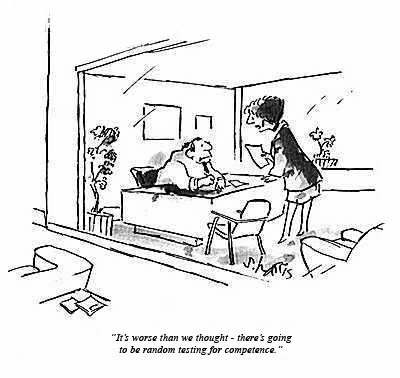
Just a funny comic about competence. 
It may not come as a surprise that this quality is one of the "21", but it brings about it's own set of challenges. The most common definition of competence is the ability to accomplish something effectively and efficiently. John Maxwell defines it as, "the leader's ability to say it, plan it, and do it in such a way that others know that you know how - and know that they want to follow you." Seems easy enough, right? Well, competence is something that is practiced and worked towards everyday. This is why we work hard to be "the best" at something. The story to go along with this chapter in the book is about Benjamin Franklin. Every night, he had a list of thirteen of his personal virtues that he graded himself on for that day. Surely, none of us goes that far, but we all work hard to be the best that we can be with our given talents. The point is to develop quality in our live whatever that may mean. The book outlines a few steps to doing this.

Show up everyday
Keep at it. They always say practice make perfect, and it truly does, If you don't believe this, you haven't practice long enough. Keep showing up everyday and working to "cultivate quality" in your life.

Keep improving
Live a goal-oriented life and always be looking for new ways to improve. Begin to understand why you do things and what makes it important to you.

Follow through with excellence
Now that you have your goals and a practice schedule, follow through with it! Do something great with the gifts that you have. It will inspire you to keep moving forward. See a pattern?

Accomplish more than expected
Wow the audience with your excellence. This does not mean that you should work to impress other, but that out of your own integrity, go the extra mile. Find the drive within yourself to do extra work when you know it's worth it!

Inspire others
Combine your personal competence with your leadership skills and lead the way for your group! 

All of these things can seem very idealistic, and determining what needs to be done is much different than actually doing it. To aid in this process, Maxwell includes a list of how to apply these concepts to your own life. 

1. Get your head in the game. 
Refocus yourself in school, life, or sports. Whatever it may be, decide to recommit yourself to it and get your head in the games. 

2. Redefine expectations.
Now that you have recommitted yourself, redefine what you expect from yourself with various activities. If you set the standard high, you are more likely to achieve it, and even if you don't, you will be farther than you were before. 

3. Set 3 specific goals.
Find 3 specific ways that you can improve in life. Set a goal that you know you can achieve with hard work. For more information, see my New Year's Resolution article. 

All in all, being a good leader begins with competence. It takes hard work, but it pays off! The next quality is problem-solving. 

Wednesday, January 2, 2013

Why You Should Never Pass Down Your Legacy to Multiple People

"A House Divided Cannot Stand"
Lincoln really knew what he was talking
about when he made these words famous. 
As I paged through my dense world history textbook and pondered the adventures of history's greatest people, I found myself questioning a pattern. Time and time again, powerful leaders of successful empires deliver their legacy to their grandchildren, generals, or relatives. Their once-great kingdoms are divided and left for the dogs (foreign invaders). Have we not heard "a house divided cannot stand"?

Alexander the Great
We have all heard of the powerful leader. He conquered the known world at the time. His army was fierce, and his tactics were gruesome. At his death, he had not named a successor to his empire. In turn, three of his top generals fought over the left over land. The kingdom was divided into Ptolemy (Egypt), Macedonia, and the Seleucid Empire (Persia). The divided land was weaker than the whole as under Alexander, but his legacy still remains as a one-hit wonder.

Genghis Khan
Look at that beard.
Genghis Khan
If you have heard of Alexander, you have probably heard of Genghis. He was born into a poor family and struggle to make a living for himself left alone a name. At a young age, he was declared leader of the Mongols, and he then conquered kingdoms to establish the largest continuous kingdom in history. With his death, his kingdom was divided between his grandsons and relatives into four main regions: the Khanate of Chagatai (central Asia), the Khans of the Golden Horde (Russia), the Ilkhans (Persia), and the Yuan Dyansty (China). How many of these have you heard of?

Charlemagne
This man is less well-known, but he did the same thing. He built the Carolingian Empire in Europe, the first kingdom to reestablish authority in Europe after the fall of the Roman Empire. After his death, his three grandsons fought bitterly over who should get it, and in the end they divided it up. It all crumbled so quickly that my textbook doesn't even name the successor states. Why didn't his legacy live on?

This has happened repeatedly in history, and I am not exactly sure what we should learn from it. Perhaps that a leadership position should not have too many co-positions. Or maybe that most legacies work this way, and sometimes no one can be the same as that one great leader. Or maybe these leaders planned it that way, so that they would be the only ones to make the history books. Who knows? All I can say is aim to be a legacy starter not a hopeless successor.

Tuesday, October 16, 2012

Nationalism and Spirit Games

A successful leader does many things to bring a group together. One of these major things is evoking a sense of nationalism. For this, I have a leadership parable.

At my school, we put on an event called Spirit Games. Each girls dorm is paired with a boys unit, and they become a team. They wear the same colored t-shirt over uniform the day before the games and the effect is fascinating. Nobody knows everyone at our school, but during Spirit Week, those wearing the same colored shirt suddenly have an incredible bond together in competition. Then when a leader is able to harness this aesthetic power toward the greater good of teamwork, a sense of nationalism together in the same color is born.

Although this is mainly due to the colored t-shirt effect, there is something to be said about building a team/group through patriotic events. When everyone is committed to something, they are more likely to be diligent in their work, and in this case, competition. However, some year even when colored t-shirts are worn to define each team, some people are simply not committed due to lack of good leadership.

Spirit Games is tomorrow, and we have the t-shirts and the leadership. We have the ability to harness the competitive spirit of our team through the group's patriotism to the yellow t-shirt. We might come from two different dorms, but together we thrive under a sense of nationalism and good leadership.

Happy Spirit Games!

Wednesday, June 27, 2012

The Avengers: Strength-based Leadership

Sitting in the movie theater last week, I found one of the best examples of strength-based leadership that involves super heroes. The Avengers is not only a fantastic movie, but also a leadership parable. One of the major tasks of being a leader is delegating which is a skill that requires knowing the strengths of your followers.

In The Avengers, Nick Fury (Samuel L. Jackson) finds himself in a bind when Loki and his army threaten to destroy the Earth. He must go to the "council" to get a pragmatic option for dealing with these terrorists. Fury brings up the idea of using a group of superheroes, and the council immediately denies it assuming that they will cause more harm than help. However, Fury uses his own discretion, which leaders have to do sometimes, and he brings in The Avengers. Iron Man, Captain America, the Hulk, Agent Romanoff (Black Widow), and Hawkeye all come to the rescue by - in leadership terms- organizing tasks by each of their strengths. In the final battle against Loki and his army, Iron Man attacks Loki at his Stark Towers and flies around distracting the monster things, Captain America works with the Hulk on the ground to fight off the smaller monster things and Hawkeye helps to shoot them with arrows from tops of buildings, and Agent Romanoff tries to close the portal. As the battle progressed as a group, they worked together using their own powers, skills, and strengths. Overall, this helped them to work more effectively, efficiently, and ultimately win the battle saving Earth from destruction.

So how can you use this in your life? You must've known I would get to it eventually. First on a side note, leaders just like Nick Fury sometimes need to use their own discretion when making important decisions. I always say to question authority, and sometimes it is necessary to successful leadership. To the main point though, delegating as leaders requires knowing people's strengths and skills. It is vital to being efficient and effective in group and team work. So how do you do that? I have one example from my own life. In my chemistry class, we did a lot of group work and mainly work where no one was really recognized if they did it all, so it was important for everyone to actually work together. In my own group, I always delegated based on strengths. In our lab groups of four, I would make sure the best person at observing and drawing conclusions was always nearest to the experiment; I made sure that the most meticulously detailed person had a pen and paper ready; and, I kept everyone on task regardless of skill. By allowing each person on a team to shine using their gifts, the whole group shines.

Next time you are in charge of a group, remember to use everyone's strengths just like in the Avengers. (Now I will end with a cheesy line..) If you use everyone's powers, even you can be a superhero.

Also, watch The Avengers. It's a really good movie.

Thursday, June 7, 2012

Tenure

Have you ever been irritated by someone who earned a position over you simply because they were older? It didn't matter what your qualifications were compared to theirs because they had "more experience". I have come to find that tenure might be the one ideal that has ruined leadership in the corporate world and has spread into the lives of every human being.

Don't they look so happy?
Everyone has their own talents, skills, and strengths. These are all developed in different people at different rate, and for good reason. This makes us unique. However, why is it that modern day systems of leadership seem to ignore the fact that some of us develop more quickly than others? I won't get into my problems with the educational system too far, but therein lies the problem. We have created a structure. An outline that students must adapt themselves to. This not only denies them of their creativity but also of their ability to grow as a human at their own pace. By handing out leadership positions to those who are of age, but not deserving, we are denying the achievements of the younger or less experienced people who are more qualified for the position.

It's the unsolvable problem, right? Like teen pregnancy and the European Debt Crisis. The reason these problems seem so unsolvable is because they derive from a long list of mistakes, and unless we suddenly realize that we have created these issues on an Etch-a-Sketch, they actually cannot be completely solved. At least not in our lifetimes. Therefore instead of stepping up to fix what's broken, we must step back and adjust ourselves. When Darwin said "survival of the fittest" he actually meant "survival of the most adaptable". So how will we adapt ourselves to this unsolvable problem? Well, like all the other doomed issues, we can stop being part of the problem and join the solution, as well as changing our lives so that the problem can no longer affect us. (Teen preganacy: be abstinate and make sure none of your friends have babies. Problem solved... kind of.)

So let's tackle this mighty road block, shall we? First of all, let's stop being the problem and join the solution. Do not condone this epidemic of tenure and allow someone older and more experienced to hold a position if the opposition is better suited for the job. Become aware of it, and perhaps others will too. Second, adapt. I have said this many times before: If you can't have position, be a leader without one. This problem is also partially rooted in the idea of corporate positions. It gives the wrong people the wrong kind of power. If we have to lie with this system, perfect your leadership skills without a position until your tenure provides you a placement. It's frustrating, but, hey, it's life.

Wednesday, May 2, 2012

Better to Be Loved or Feared?

Recently in class, we read The Prince by Machiavelli. It was published in 1513, as a sort of instruction guide to leaders in the court. Despite its age, this literature can give even young leaders today powerful insight into how to be an efficient leader.

I have asked myself this question many times:

"Is it better to be loved or feared as a leader?"

When I am with a group of my friends and we need to get something done, often I don't want to be feared in the moment, but sometimes it seems like the only way. It is difficult to find a balance, especially among friends, of kindness and harshness. When is it okay to be cold, and when should you let things slide. It is a test of strictness.

However, look no further than 499 years ago with Machiavelli's wisdom. He was a diplomat to the Republic of Florence in Italy. The Prince has many parts, but the section "Concerning Cruelty and Clemency, and Whether it is Better to be Loved than Feared" will answer our question:


"Upon this a question arises: whether it is better to be loved than feared or feared than loved? It may be answered that one should wish to be both, but, because it is difficult to unite them in one person, it is much safer to be feared than loved, when, of the two, either must be dispensed with. Because this is to be asserted in general of men, that they are ungrateful, fickle, false, cowardly, covetous, and as long as you successed they are yours entirely; they will offer you their blood, property, life, and children, as is said above, when the need is far distant; but when it approaches they turn against you. And that prince who, relying entirely on their promises, has neglected other precautions, is ruined; because friendships that are obtained by payments, and not by nobility or greatness of mind, may indeed be earned, but they are not secured, and in time of need cannot be relied upon; and men have less scruple in offending one who is beloved than one who is feared, for love is preserved by the link of obligation which, owing to the baseness of men, is broken at every opportunity for their advantage; but fear preserved you by a dread of punishment which never fails. Nevertheless a prince ought to inspire fear in such a way that, if he does not win love, he avoids hatred; because he can endure very well being feared whilst he is not hated, which will always be as long as he abstains from the property of his citizens and subjects and from their women."
Basically, "A prince ought to inspire fear in such a way that, if he does not win love, he avoids hatred." Machiavelli explains that men are selfish and cowardly; therefore when you are feared, they will be yours. However, as soon as danger approaches they will turn against you. This is why you also need to balance a good amount of love with it. In his opinion, fear comes first, but you still need love so that they will respect you. So, is it better to be loved or to be feared? Ask Machiavelli.

Tuesday, April 17, 2012

"Too Many Bosses, Too Few Leaders" by Rajeev Peshawaria

"The boss assigns the task; the leader sets the pace. The boss fixes the blame for the breakdown; the leader fixes the breakdown. The boss knows how its done; the leader shows how. The boss makes work a drudgery; the leader makes it a game. The boss says, "Go"; the leader says "Let's go!"
This is a poem by Albert Edward Wiggam. Too many times I have seen a person's success defined by their position, material awards, and others congratulations. Often the real success is not seen. Often the leader who actually brought the team together is not fully recognized or given the glory that they wanted from the start, because that is not what being the leader is. That is being the boss.

I picked up a book at the library the other day called "Too Many Bosses, Too Few Leaders" by Rajeev Peshawaria. Although most of the book is directly linked to the business world, there are many leadership lessons that can be applied throughout one's life. It focuses on the "three essential principles you need to become and extraordinary leader". It seems a bit cliche, but it pretty much outlines the basics of successful leadership, and since leadership can't be taught, it makes sense. Here are the three principles in an excerpt from the book:
 "So how did Gandhi, and how do other great leaders, accomplish so much? With all the investment in leadership development, what is the elusive key to effective leadership? In my view, it is that superior leadership requires incredible amounts of emotional energy- the power to stay the course despite the most formidable of obstacles. Emphasis is most often placed heavily on cerebral skills at the expense of appreciating this crucial source of leadership success. Again, leadership is not about competency models, personality traits, or formulas- it is about having the lasting energy to stay true to your vision for positive change even in the face of the most powerful resistance. Leaders who achieve exceptional results despite the toughest challenges are able to do so because they know how to:
  1. Identify sources of unlimited emotional energy to fuel THEMSELVES.
  2. Enlist a few co-leaders and align their energy toward a shared purpose.
  3. Galvanize the energy of large numbers of people to create sustainable collective success."
 Do not let positions define you or others as leaders. Gandhi was never given an official position of leadership; however, he managed to gain thousands of followers. I encourage you to skim the book, it has some great ideas.

 Peshawaria, Rajeev. Too Many Bosses, Too Few Leaders: The Three Essential Principles You Need to Become an Extraordinary Leader. New York: Free, 2011. Print.

Monday, January 2, 2012

You Can Be a Leader (Part 1)

We know a little about self-leadership and the character it takes to lead others, but let's go further in-depth. How do you use it and why do we need it?

The Character Traits

Dedication: It is important for all leaders to be dedicated to the cause at hand.
Integrity: You need to be trustworthy and able to keep your promises. Practice what you preach.
Judicial: Be fair, and try to be objective in controversial topics.
Straightforward: Don't beat around the bush. Be honest with your followers, they will appreciate it.
Looking to the Future: Keep an eye out for the future, and always work toward a goal.
Inspire: Motivate and encourage.
Optimism: In leadership, this can also be bravery. Keep looking forward, and your followers will too.
Problem-solving: Be creative, and find solutions that work. 


Character is unique to each individual. However, you can work on your weaknesses in character in order to better yourself as a human being. To find what your character strengths are, I recommend the VIA Survey of Character Strengths. I have attached the link to the site: Character Strengths Survey . You must register (which is kind of a pain), but it is really helpful to see all of your strengths and weaknesses mapped out and then go back to look at them later. I took the survey and my top five strengths are hope, persistence, spirituality, bravery, and curiosity. There is actually a strength called leadership. I consider that one more of being able to round up followers rather than being able to lead, but if you find that you have that strength, GREAT! Above is just a list of the basics. If anyone has other ideas that add to the strength of positive leadership, feel free to comment.


How do you use them?

By taking the strengths survey, you answer questions that describe how you actually act. In the end, the strengths shown should be accurate to your daily life. When you want to acquire a new skill, work on it. Practice, practice, and more practice. If you want to be more inspiring. Find what inspires you, and try your hand at inspiring others with it. (See my New Year's Resolutions article, that is what I did) Be creative and find ways to get better at your character weaknesses that are important for leadership.


Why do you need them?

As a leader, you are also a role model. Someone that others aspire to be. However, it is a large responsibility to be an effective, positive leader. It takes all of these character traits and more to do it. By acquiring these skills, you will be able to lead effectively, but only if you use them.

You Can Be a Leader (Intro)

Some people might believe in being born with talent. I do not. The skills it takes to be an artist, to be flexible, and to be a leader can all be acquired. I will start this leadership series with two quotes.

"The only place where success comes before work is in the dictionary." Vidal Sassoon

 “Hard-work beats talent if talent doesn’t work hard.” --Unknown

Some people grow up in an environment where the acquire the skills it takes naturally. They just had a head start, but if they don't use their talent, what is the point? I encourage anyone who wants to better themselves through leadership to follow this series. We will go through what it takes character-wise to be a leader, the behind-the-scenes of leadership, and the skills required to lead others. Please join us on this series to better yourself to benefit others. 

Saturday, December 31, 2011

New Year's Resolutions

There are no limits.
Have you ever written New Year's Resolutions? Goal setting is one of the best ways to improve yourself. In order to lead others, you must learn how to lead yourself. (See my post on Self-leadership)

I have a different philosophy on goal setting. It derives from Michael Phelps' book, "No Limits: The Will to Succeed". My philosophy is this: Don't set your goals low enough so you won't be disappointed if you fail, set them high so you can celebrate when you reach them. At my school they taught the the SMART goal setting strategy. It stands for Specific, Measurable, Attainable, Realistic, and Timely. I disagree with this. I say, dream big. By setting "attainable" and "realistic" goals, you are only cheating yourself of being truly successful. Yeah, they should be specific and measurable and blah, blah, blah. DREAM BIG. Don't settle for the easy goals.

Here is an except from Michael Phelps' book, "No Limits: The Will to Succeed" to inspire you:

"So many people along the way, whatever it is you aspire to do, will tell you it can't be done. But all it takes is imagination. You dream. You plan. You reach. There will be obstacles. There will be doubters. There will be mistakes. But with hard work, with belief, with confidence and trust in yourself and those around you, there are no limits. Perseverance, determination, commitment, and courage- those things are real. The desire for redemption drives you. And the will to succeed- it's everything."

Set some goals for 2013 in order to better yourself at whatever. Whether it is sports, school, or life in general, plan to achieve. Don't set them too low, dream BIG. Have a happy New Year!

Why Do You Want to be a Leader?

This might be a strange question, but it is definitely something to think about. Most of the time, teens want to be leaders to fulfill their purpose in life, become popular, or have control over someone else, but what if that is not what is all about? When people step up to a leadership position for the first time, it takes a lot of responsibility. Yeah, you might get the fame and surely popularity, but the responsibility required to be a positive leader is what gets most people.

Here is a little bit of history. George Washington was the most popular, not to mention powerful, man in America during the late 1700s. He was unanimously elected president and served for two terms. At the end of his second term he declined, which instated the law that no president can serve for more than two terms (8 years). Why wouldn't he want to keep going for a third term? Everyone loved him. He was famous, powerful, and had an important purpose established, but he took the responsibility onto himself to say that any longer is too much. Power-hungry leaders could become corrupt and the nation could turn into a state of confusion.

Think back on why you want to be a leader. If it is for wealth, popularity, or fame, think about the responsibility required. Is it worth it? These reasons lead to corrupt governments. But if you have a passion for the purpose and determination for the cause, by all means, go for it. Wealth, popularity, and fame are produced in the process, but they should never be the reason for stepping up to the plate.

Feel free to make comments on why YOU want to be a leader. Happy New Year's Eve!

Friday, December 30, 2011

Kim Jong-un

For those not keeping up on current events, Kim Jong-un is the sucessor of Kim Jong-il the former dictator of North Korea who died on December 17, 2011. He is not the eldest son, but he was chosen to continue the dynasty. This is not a typical leadership system and we cannot expect it to be considering all of the revolutions for democracy, but we can learn from his leadership. 


He is about 27-28 right now and has assumed power over the most isolationist, dangerous, and possibly nuclear country in the world at this point. What's next? Everyone seems to expect him to fail, but little can be confirmed about his life at all. I encourage all of you to watch the news or the internet and see how this goes down. No matter what happens, we can all learn from the choices that he makes in his position, good or bad. 

Wednesday, December 28, 2011

Be a Leader on Campus

Whether you are in high school or college, there are plenty of ways to practice your leadership on campus. Here is a list of great activities to get involved in to work on your leadership:

1. Sports: Lead others to better themselves in a given sport. You don't have to be a team captain to be a leader on the team, just show others that you have something to be followed and that you can help others.

2. Student Government: Although student governments can often be a complete mess, showing good leadership in problem situations is an incredible skill. Run for a position and gain support. Sometimes the elections are pure popularity contests, and if you do not win, there are plenty of other leadership opportunities available at any high school or college. 

3. Model United Nation: If you are a political junkie or have a knack for speaking and negotiations, Model UN might be for you. Most colleges have a team (or delegation) and some high school have teams. This club is very time consuming. It takes a lot of research, but is a great place to let your leadership skills shine.

4. Honor Societies: Honor Societies usually require more than just leadership skills, but they are a great way to practice them. Apply for one and lead others!

5. The Classroom: One of the best ways to practice your leadership skills is in the classroom. If you are doing a group project, take the lead. If you are excelling in a given course, offer to help others that are struggling.

6. Campus Clubs: Service clubs, school newspapers, ski club?! Whatever it is, take charge. Find a club that you are interested in and get more information. Get involved and take the lead.

7. Everyday leadership: If you are an older student or just more experienced, you have the opportunity to lead every day. If a younger student needs help, give it! Always be ready to lead others.

There are plenty of ways to practice your leadership on campus. Always be ready for new opportunities and keep an eye out for positions. Keep in mind leadership positions are given to those who are experienced. You will most likely not be able to gain leadership as soon as you join a club or activity, but as soon as you have something to follow, people will. If your campus seems to be missing a club/activity, lead by filling that hole! Leadership opportunities are everywhere, seize them!

Saturday, December 24, 2011

Self Leadership


Before you can ever lead others, you must check to make sure that you can lead your own life. A leader is someone that people can look up to as a role model, or someone who just knows what they are doing. To make sure you know what you are doing, ask yourself these questions:


Do you procrastinate?

Do you tell white lies?

Are you always on task?

Do you forget things because of lack of planning?


Do you care more about yourself than you do others?

Are you a people person?

Do you like to help others?

Are you compassionate?

Do you perform well under pressure?

These are just some things to think about before attempting to lead others. In order to take on the responsibility of leading others, you must be able to lead yourself successfully.